Loading...
When autocomplete results are available use up and down arrows to review and enter to select. Touch device users
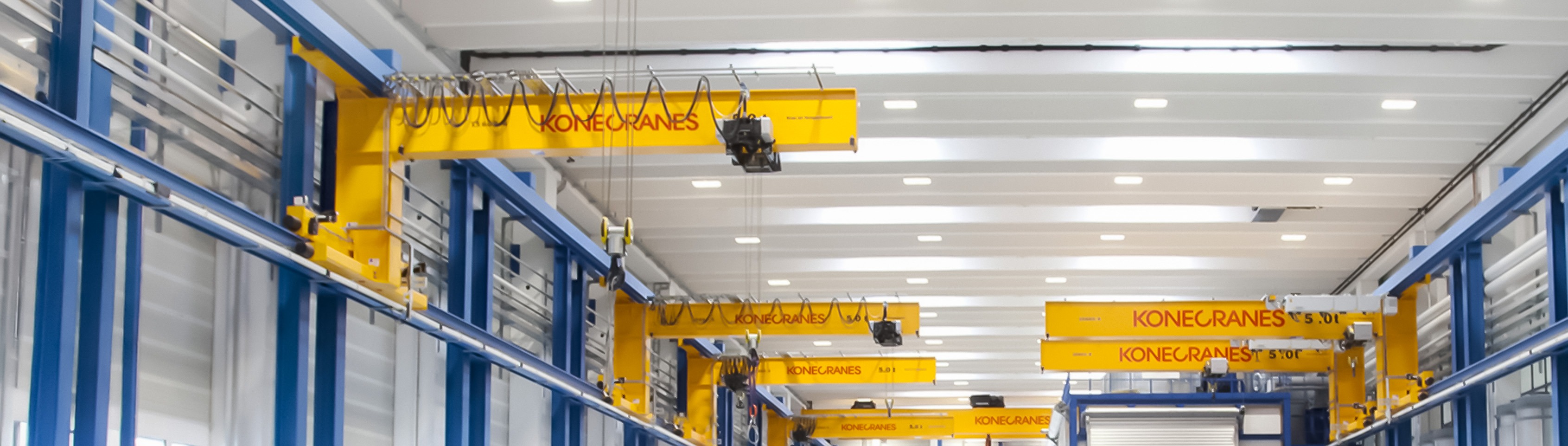
KC_hero_welcome.jpg

Welcome to Konecranes Portal

Konecranes Portal is your single point of access to our digital customer platforms. If you have a Konecranes service agreement, you get quick and easy access to your crane maintenance information, asset condition and usage data, quotations and more. You’ll also be able to browse and order spare parts, manuals or accessories for many brands, makes and models of industrial cranes and hoists.

Elevate our partnership to a whole new level

By joining our portal you’ll get:
  • All operations and activities in one place
  • Visibility to risks
  • Guidance related to your needs
  • Relevant topics

Industry trends and insights

Article

The Siemens S7-300 is being phased out — here's what that means for your warehouse

If your warehouse operations rely on a Siemens S7-300 PLC, it's time to start planning ahead. Siemens has moved this product family into its formal end-of-life process, and while nothing changes on your site today, the window for a calm, well-planned upgrade is narrower than it looks.

Read more

Article

Frequent inspections are the regular health checks your overhead crane needs

Think of frequent inspections as the routine check-up your crane needs to keep running safely. Unlike a full physical exam, this is more like checking vital signs—quick, regular looks at the parts of the crane that see the most action and wear out the fastest.

Read more

Customer story

Overhead crane supports pallet handling at ISOKON in Slovenia

ISOKON is a Slovenian manufacturer specializing in technical plastics for industrial applications. At its production facility, efficient material handling plays an important role in keeping production running smoothly. ISOKON has worked with Konecranes since 2023, when a crane system was integrated into a robotic production line. Following the successful implementation of that project, ISOKON selected Konecranes again to supply lifting equipment for a new production line where pallets with boards need to be transferred frequently and positioned accurately.

Read more

Article

Variable speed control upgrades for overhead cranes

The drive technology on an overhead crane has an outsized effect on how the crane performs day to day. Old or outdated variable speed controls don't just create maintenance headaches; they hold back the people using the crane. Modern inverter technology has advanced considerably, and whether your crane already has inverter control or is still running on two-speed contactors, an upgrade can bring big benefits.

Read more

Article

Why a spare parts package is a smart investment for your overhead cranes

When it comes to keeping overhead cranes running, having the right parts on hand at the right time can mean the difference between a minor maintenance stop and a costly, extended shutdown. A spare parts package takes the guesswork out of parts planning. And for facilities where cranes are critical to daily operations, that kind of preparedness pays for itself.

Read more

Article

See the crane coming: how safety lights protect people on the floor

An overhead crane moving through a busy facility is easy to miss. People are focused on their work, noise levels are high, and the crane is up above—not where most workers are looking. By the time someone notices a load swinging overhead or a hook descending toward their work area, they may not have much time to react.

Read more

Article

Is your wire rope as safe as it looks?

Wire rope is one of the most critical components on an overhead crane. It's the link between the hoist and the load. And when it fails, the consequences can be serious. But here's the problem: wire rope can look perfectly fine on the outside while deteriorating on the inside, which means visual inspection alone doesn't always tell the full story.

Read more

Article

Why hoist replacement creates long-term value

There are plenty of reasons a hoist reaches the end of its useful life. Components wear out and hit the limits of their service life. Breakdowns accumulate until repair stops making economic sense. Periodic inspections surface replacement recommendations that can't be deferred. Sometimes the hoist itself is fine, but the operation around it has changed because of higher production volumes, different load profiles, or shifts in how and where the equipment is used. Statutory requirements evolve too, and what was compliant a decade ago may no longer meet current standards. And sometimes the calculation is straightforward: a new crane is out of budget, but a new hoist achieves what's needed at a lower cost.

Read more

Article

Keep your crane working: everything you need to know about a general overhaul

Every time a crane lifts a load, machinery components in the hoist accumulate wear. That's simply the nature of mechanical equipment. Components experience fatigue over time, and as they do, the theoretical service life of the hoist gradually decreases. Left unaddressed, this means a higher risk of failure, unplanned downtime and costly emergency repairs. A general overhaul is how you reset the clock.

Read more

Article

Understanding the impact of electrical issues on overhead cranes

Overhead cranes depend on electrical systems to power movement, control loads and activate critical safety functions. While mechanical wear is often visible, electrical issues can develop quietly. And when they do, their impact can be immediate, wide-ranging and costly.

Read more

Article

When did you last check your overhead crane's geometry?

Your overhead crane might be running every shift without a single breakdown. But running and running well are two different things. Some of the most damaging crane problems develop slowly and quietly, long before anything actually fails. Geometric misalignment is one of them.

Read more

Article

Crane operator training: why it matters and why it should be ongoing

Operating an overhead crane may look pretty simple—just a pendant or radio with a few buttons for up, down and travel. But safe and effective crane operation is much more than pushing controls. Used correctly, a crane makes lifting operations faster, safer and more efficient. Using a crane incorrectly can lead to issues that bring production to a halt, damage expensive equipment or even cause serious injury. The difference between those two outcomes often comes down to one thing: proper operator training .

Read more

Article

Small, hidden and critical: Why hoist couplings deserve more attention

Most crane operators and facility managers spend a lot of time thinking about the big, visible things on an overhead crane: the hook, wire rope, brake and load. And that makes sense because those are the things you can see. But some of the most consequential components in a hoist are the ones you can't easily see, tucked away inside the hoist, doing critical work on every single lift. The hoist coupling is one of them.

Read more

Article

The real value of a major inspection for overhead cranes

If your overhead crane is approaching, or has passed, the point where a major inspection is due, it’s natural to ask: Why is this needed now? We already do inspections. What’s different about this one? A major inspection is not just another box to tick. It serves a very specific purpose—and can be one of the most important decisions you make about the future of your equipment.

Read more

Article

Overhead crane load testing: safety, compliance and confidence

Inspections on overhead cranes are key to identifying wear, corrosion and damage. But they can't replicate what actually happens to a crane when it's lifting a heavy load. A load test can. By putting the crane through its paces under real operating forces, it can expose hidden fatigue cracks, structural deformation, or degraded braking performance that that could otherwise go undetected until it caused a failure during normal operation. In other words, it's both a safety check and an early warning system—giving you documented proof that your crane is ready to work, or a clear picture of what needs fixing before it is.

Read more

Article

Stay current and in control with periodic compliance inspections

In many industrial facilities, an overhead crane isn't just a piece of equipment, it's the heartbeat of the operation. So, when the calendar shows a compliance inspection coming due, the instinct may be to look at the production schedule first and find a reason to push it. But delaying a periodic compliance inspection doesn't buy you time—it borrows it, at interest. Because a compliance window is a legal boundary, not just a scheduling preference. Cross it and your crane's compliance status changes the moment the deadline lapses, not the moment anyone notices. That's a risk worth understanding before you decide to wait.

Read more
View all articles